Tuesday, August 4, 2020

Hugh's Story- Jerseyville- Family timeline for Margaret Durney 1840-1884 and Hugh Allen 1834-1891 with documents

Timeline for family of Margaret Durney 1840-1884 and Hugh Allen 1834-1891


1834- March 3- birth of Hugh Allen, Great Umberstown, Summerhill Parish, County Meath Ireland

1840- January 1- birth of Margaret Durney, Garryduff, Templeorum Parish, County Kilkenny, Ireland

1863- April 20- Hugh Allen gets a mortgage for his 120 acre farm in Jerseyville for $1000 due in five years with 10% interest

Source: in possession of cousin Hugh Allen, Jerseyville

1863- July 1- draft registration for Hugh Allen 25 and his brother Francis 30

Source: p 22, Illinois 10th, vol 1-National Archives and Records Administration (NARA); Consolidated Lists of Civil War Draft Registration Records (Provost Marshal General's Bureau; Consolidated Enrollment Lists, 1863-1865); Record Group: 110, Records of the Provost Marshal General's Bureau

1864- April 25- Marriage, Jerseyville

Source: Roman Catholic Diocese of Springfield Sacramental Records, St. Francis Xavier, p 343

1865- birth February 28/baptism April 2- son Richard Allen, sponsors Michael Durney ad Anna Byrns at St. Francis Xavier
Source: Catholic Diocese of Springfield; Springfield, IL; Illinois, Church Records, 1853-1975

1865- July 3 Illinois State Census- Jerseyville

Source: p. 72 Illinois State Archives; Springfield, Illinois; Illinois State Census, 1865; Archive Collection Number: 103.010; Roll Number: 2177; Line: 1

1867- October 17 birth/Nov 4 baptism- dtr Margaret Allen, sponsors Patrick Allen and Mary Durney at St. Francis Xavier

Note: this record refers to Jos/Jas Allen and Margaret Durney- was Hugh's Christian name Joseph or James?
Source: p. 218, Catholic Diocese of Springfield; Springfield, IL; Illinois, Church Records, 1853-1975

1868- August 14 birth/baptism of dtr Rose Anna, sponsors Richard Allen and Bridget Power


Source: Catholic Diocese of Springfield; Springfield, IL; Illinois, Church Records, 1853-1975

1870- December 21/Jan 5- birth/baptism of son Thomas Allen

Source: Catholic Diocese of Springfield; Springfield, IL; Illinois, Church Records, 1853-1975

1870 census-


Note: Hugh is now listed as 40 (despite being listed as 29 five years earlier) and Margaret as 29 (listed as 25 five years earlier.) The farm is valued at $4000, and their personal property at $880. Hugh's younger brother, Patrick Allen, age 29, is living with them as a farm hand. Patrick cannot read or write.

Source: Year: 1870; Census Place: Township 8 Range 12, Jersey, Illinois; Roll: M593_233; Page: 796A; Image: 811; Family History Library Film: 545732 p. 30

1873- March 5- birth of son Hugh Allen
Source: Illinois, Deaths and Stillbirths Index, 1916-1947

1874- November 3/December 8- birth/baptism of dtr Mary Anna Allen

Note: This is the first record we have of this child; she did not show on any family records so likely died very early, although no burial record was found- she is not on the 1880 census 

Source: p. 266 baptisms St Francis Xavier-Catholic Diocese of Springfield; Springfield, IL; Illinois, Church Records, 1853-1975

1880 Federal Census- 


Note: Hugh now shown as 45, Margaret as 40. Hugh's younger brother Edward Allen, age 30, is now living with them as a farm hand.

Source p.1 Year: 1880; Census Place: English, Jersey, Illinois


1880 US non-population Census source Selected U.S. Federal Census Non-Population Schedules, 1850-1880


Note: Hugh is the owner of 115 acres of tilled land, 42 acres of pasture, 43 acres of woodlands, valued at $10,000. His farming machinery is valued at $300 and his livestock is valued at $790. Cost of fencing and repairs $450, labor $560. He has 14 acres of mown, 26 acres of not mown grass, and 7 acres of hay. He has 54 acres in corn, some oats, and 55 acres of wheat. He has a 2 acre orchard with 40 trees that produce 80 bushels of fruit. He does NOT grow any potatoes! (see 1880 non population census- very hard to read!

1884 November 11/ November 13 death and burial of Margaret Durney, age 45


Note: Margaret died of consumption. Richie was 19, Margaret 17, Rose 15, Thomas 14, and Hugh Jr. 11. Hugh never remarried.

Buried St. Francis Xavier Cemetery


1891- April 27- burial of Hugh Allen


Source p589- Illinois, Roman Catholic Diocese of Springfield Sacramental Records, 1853-1975

Burial St. Francis Xavier


1891 May 4-Probate of Will of Hugh Allen- source probate records Vol B-D. Illinois, Wills and Probate Records, 1772-1999, Probate Records; Author: Illinois. County Court (Jersey County); Probate Place: Jersey, Illinois


Wednesday, July 29, 2020

Mysteries and Clues: Resources to research our ancestors in Ireland- County Meath


Meath

1828 Tithe Applotments (our ancestors were in Laracor Civil Parish)

Search the 1828 Tithe Applotment Books (our ancestors and their families were mostly in Umberstown, Ballinrigg, and nearby townslands)

Allens in Laracor Civil Parish; 1828 Tithe Applotments

Sweeneys in Laracor Civil Parish 1828 Tithe Applotments


Summerhill RC Parish records- marriages, baptisms, deaths 1812-1881

Summerhill RC Parish Records online

Places in Laracor Civil Parish with links to Griffiths 1855, and 1901 and 1911 census  (Our Allens and Sweeneys were in Great Umberstown, but likely had close relatives in Dangan, Ballinrigg and a few other townlands)


Children of Richard Allen and Margaret Sweeney County Meath- marriage traditions Before and After the Famine


               Hugh Allen and Margaret Durney's Marriage- April 25, 1864

When Hugh Allen got married at age 30, his marriage was influenced by Irish cultural patterns that had existed for hundreds of years, some of which changed abruptly after the Great Famine of 1845-1852.

He knew, like all Irish farmers, that acquiring land for farming was the basis on which a marriage was built. He bought his land and established a farm a year before he actually married and started a family. But he had to leave Ireland to achieve this goal.

Before the Famine (Before 1845)

Before the famine, most Irish fathers traditionally divided their farms to provide farms for their married sons. With the willingness to divide land into smaller plots, every son could expect the possibility of marriage by their early 20's. Even if a father could not/would not oblige, a young man could turn to a neighbor to get land. The last resort was to sublet a "conacre" where he would pay a portion of his crop or his own labor to the main tenant in exchange for a short-term lease- but this arrangement offered little security to a young couple. Even holdings of a few acres would likely be enough of a start for a young couple. It was not unusual to see holdings of only 3 acres supporting a family.

Hugh's father, Richard Allen, was much better off than this; he leased a house and 17 acres in the tiny townland of Great Umberstown directly from the wealthy landowner, Charles P. Leslie, and subleased a house and garden to John Allen, who, no longer needing land to farm, was likely Hugh's aging grandfather.

A nearby neighbor in the same townland was Patrick Sweeney, who had 16 acres of land. Since Richard's wife Margaret was a Sweeney, and there are no other Sweeney's in the Parish, we can assume that Patrick is Margaret's kinsman.  Richard and Margaret's parents likely followed a traditional pattern of marrying their children to nearby neighbors - often in order to protect their land interests.
Like most couples, Richard and Margaret had probably known each other from childhood. Even those that did not marry a next door neighbor likely knew their intended from childhood. Couples were likely to marry from within the same Parish- in the case of Richard and Margaret, both attended the nearby Dangan Church in Summerhill Parish. Travel was by foot in those times so courtships were almost always within the close community.

Marriages in those days (and those that followed) were rarely a romantic concern. If fathers did not arrange marriages themselves, matchmakers and marriage brokers stepped in to bring couples together. They worked with the fathers of the bride and groom to come to an agreement based on the dowry or "fortune" the bride could offer in order to balance out the value of the groom's farm. Land was the key to marriage; men without land who were just hired laborers were not considered for marriage to a farmer's daughter.

As fathers subdivided their land leases to provide for married sons, many farms became smaller and smaller- some as tiny as those of 3 acres that make us wonder how the families survived.

After the famine (1850's)

After the famine, things changed. So many people had died, been evicted, or emigrated, that the larger landlords began consolidating holdings in order to allow for more profitable pasture land. Small tenant farmers were inspired by the letters from family abroad, many of whom, like our ancestor Hugh, were now very successful farmers. Fathers were less likely to subdivide their farms, and held on to the property until their death or old age.

As a result of this, sons often delayed their marriages, having little of their own to offer a wife. If single, they could more easily save their money for the dream of emigration and hope of a better future. Many sons who did not emigrate abroad moved elsewhere to find employment. Others entered religious orders, which grew dramatically after the practice of subdivision had faded away. Others stayed single, helping as laborers and often contributing greatly to the success of the farm. Some perhaps hoped that they might one day inherit and then left to seek their fortunes elsewhere if they did not. Inheritance was not limited to the eldest son, in fact it was often the youngest son, who stayed on the farm with his aging parents, who ended up the heir.

Marriage was not easy for young girls in these circumstances. Fewer young men were marrying and finding a husband became more difficult. A woman with a good temperament would be an attractive addition to the family; caring for aging parents and providing grandchildren. But a woman who also had a good dowry might allow for others in the family to emigrate abroad, or help provide a dowry for the girls within the family so that they could marry. After the rigors of the famine, parental controls over the practicalities of marriage increased more than ever, and children understood the need to help support and maintain the family as a whole.

We see these patterns in the Allen family. The eldest daughter, Mary, married Patrick Burns at the Dangan Church in 1851 when she was 25. They quickly emigrated to start a family in America. The eldest son, Frank, also emigrated, and by 1861 they were both in Jersey County, Illinois.

The next eldest son, John Allen, stayed on the farm in Ireland with his parents, along with the youngest son, Edward, and youngest daughter, Catharine.

The middle five sons had little hope of inheriting land; Hugh, Patrick, Peter,Tom, and Richard emigrated as single young men, hoping to make their way in the world and find their brides in America. They helped each other out until they could each save enough money to buy a farm and marry, except for Richard Allen, who emigrated but never married, dying in 1872.

Little Catherine, born at the height of the famine in 1847, married in April 1872, when she was 24 years old. But she married a man twice her age; 49 year old Owen Byrne.

The youngest son, Edward Allen, still single at age 36, finally left home in 1880. We might guess that he waited to leave until after his parents death, as they married in 1825 and would have been elderly by that time. Edward married Mary Bryne in 1885 in Jerseyville, later moving to a farm in Nebraska.

The farm was eventually left to John Allen, who never did marry. Richard Allen and Margaret Sweeney had died by the time of the 1901 census, but John was still living on the farm, with a 19 year old cousin named Jane Moran. This goes along with Aunt Helen's stories of writing letters back from her Uncle Tom Allen to John Allen in Ireland. John could not write either (as is noted on the census) but had a young female relative who would write letters for him. But when John reached his later years, he had no children of his own to care for the farm. In 1911, when he was 76 years old, his sister Catherine's son, Thomas Byrne, age 37, was doing the farming. We don't know when John died, or who inherited the family farm in Ireland, as he had no sons of his own.

The pattern of marriages after the famine worked out well for our family in America. Despite (or because of) delaying marriage, most of those who emigrated managed to save money, buy a farm, and marry. Most became successful farmers with large, healthy families. But for those who remained in Ireland, marriage after the famine was so difficult that many never married at all.
The population decrease because of death, emigration, and single adults who never married or delayed marriage, having fewer children had a significant impact in the years to come.


History: January 6, 1839- The Night of the Big Wind


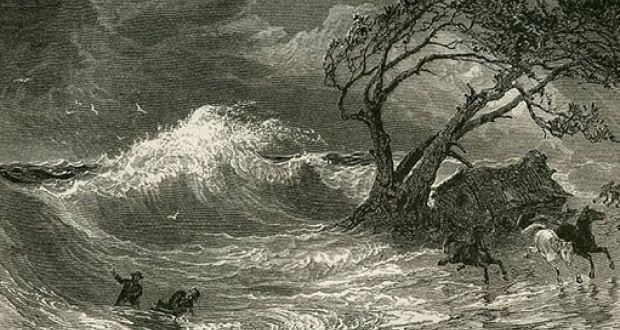
January 6, 1839- The Night of the Big Wind- the worst storm in Ireland's History

Image result for the night of the big wind in county meath

Inside their cottage, Margaret Sweeney Allen was looking forward to "Nollaig na mBan" also known as "Little Christmas," the Feast of the Epiphany. In Ireland, a sweet tradition held forth that on "Little Christmas" or "Women's Christmas," the women of the family had a much anticipated day off from their household chores. For the rest of the year, a man would be ridiculed should he lift a finger to help with women's work, but on January 6th, the men of Ireland gave their wives the night off. They cared for the children and handled the household chores so the women could leave the home to gather with their female friends and family and celebrate their own "Little Christmas" without all the cooking and other chores that had been their responsibility during the preceding Christmas season. The hard working women of Ireland looked forward all year to this, their special day. Children often gave their mother's small gifts, as children do today on Mother's Day. This year Margaret had a big family to be thankful for;Mary was 13, Frank 10, John 7, Hugh 5, Patrick 4, and the baby, Peter, was only 2.


But this year the celebration was not to be. On Saturday, a heavy snow fell across the county, the first snowfall of the year. However by Sunday, the weather turned warm and eerily still. After they attended church that morning the snow was melting to slush, and as they had their Sunday dinner, a gentle rain began to fall. As it turned dark, which happened early in the winter in that northern latitude, the rain became a storm. Soon hail. sleet, and heavy rain were pounding the windows and the roof. As the children went to bed, Richard and Margaret worried at the intensity of the storm. All night it raged, wreaking havoc upon the land around them and on their own small cottage.

Reports show that many roofs gave way or were blown off by the hurricane strength winds, many precious glass windows were shattered. Chimneys were brought down and families fled their homes to avoid being crushed or killed. Some fled to neighbor's homes or nearby churches, others huddled for temporary safety in low lying areas the countryside, soaked to the skin in the freezing rain. Many fences and stone walls were also collapsed, and livestock ran in fear. Fires spread from the turf fires which were kept burning in every cottage, alighting the thatch roofs.

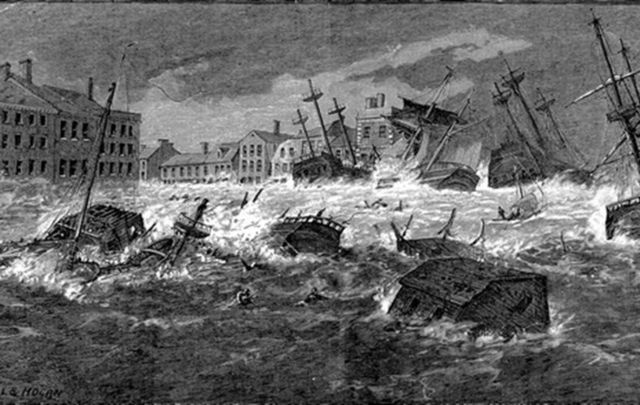
In nearby Dublin, the Shannon flooded. The great trees in the parks were blown down, and even stone buildings collapsed. The bell from St. Patrick's Cathedral was tossed out like a toy. As buildings fell, fires spread throughout the city. It is said that a quarter of the buildings in the city were destroyed.

Image result for night of the big wind 1839

The surges of the sea were so great that it was said that waves came up over the cliffs of Moher on the east coast, and on the west coast near Dublin the flooding sea enveloped the land. Ships under sail and in the harbors were wrecked, their passengers drowned.

The aftermath found many families in Meath homeless, their roofs gone, stone cottages damaged, their crops badly ruined. In the midst of winter, it was a devastating experience that would not be forgotten in the lifetimes of those who lived through it.

(You may want to read- "The Big Wind- a novel of Ireland" by Beatrice Coogan)


Saturday, July 18, 2020

Children of Richard Allen and Margaret Sweeney County Meath- Catherine Allen Byrne Part 1


Catharine Allen was baptized in the Dangan Church in Summerhill Parish on May 21, 1847- at the height of the famine. Her sponsors were Thomas Murren and Ellen Sweeney- likely her mother's sister.


She was the youngest in a family of ten surviving children of Richard Allen and Margaret Sweeney. Times were hard and there were many mouths to feed. She must have watched her parents struggle through those lean years following the famine. As a very young child, she watched Mary, her eldest sibling and only sister marry and emigrate to America. Then, one by one, she watched her brothers go. First Frank and Hugh, then Patrick, Thomas and Richard. There were no prospects for them on one tiny rented plot of land in Umberstown. It could not sustain them or permit them to marry and raise additional families. But the cherished letters that came back from them in America were full of hope and promise. They owned their own farms now, and several of them were married and had growing families. They had great plans for the future. Even her parents, who mourned knowing that they would never again see their beloved children, must have been joyful that their lives in America were so different from the bleak future that would have faced them in Ireland.

Catherine stayed on the farm to care for her aging parents- probably until their deaths. We don't know for sure, but believe that they had both died by 1866. After that only John, Edward, and Peter remained on the farm, and Edward and Peter were anxious to follow their brothers to America. Catherine would have cared for the three brothers; cleaning the house, doing the laundry, and cooking the meals. It was a dreary life for a young girl. After the famine, there were few enough young men of her own age who had the means to go courting. Many of the survivors who had the courage and the means for travel had left Ireland for good. Others stayed single, realizing they could never afford to marry and raise a family.

The man who asked for her hand was settled with a farm but was much older than she. Owen Byrne was 49 years old to her 24. He was a widower with 5 children, the eldest few barely younger than herself. Two of the boys were grown; Richard 21 and Edward 18. James was 15, Elizabeth 12. The baby, Eugene, was only 4; his mother had died after his birth. 
For a time the Byrne family had lived in Dangan, so Catherine knew them from church. She surely understood what her life would be after the marriage. She would take on housekeeping as both a step-mother and a wife. And yet it must have been a good match, for Catherine agreed.
She married Owen Byrne at the church in Dangan on April 10, 1872.


By that time, Owen and his family were living in Clonmahon, on the edge of the town of Summerhill. Catherine's first son, Thomas Byrne, was born on May 4, 1873.


Her next child was a daughter, Margaret "Maggie" Byrne,  born April 25, 1875. Catharine's brother Edward "Ned" Allen was one of the baptismal sponsors.


A third child followed in June 1877. This daughter was named after her mother, and Catharine's brother Peter Allen was one of the baptismal sponsors.


I cannot find another baptismal record for ten years, but in 1877, Edward Byrne was born.

The 1901 census shows Owen Byrne 78, Catherine 50, Thomas 26 and Edward 13, living in Summerhill Parish in the townland of Clonmahon- about a mile from the Dangan church. Owen and his son are farming, and Edward is still in school. Everyone in this family can read and write, and they live in a nice house with 5 rooms- unusual for this time.

Ancestry.com. Web: Ireland, Census, 1901 [database on-line]. Provo, UT, USA: Ancestry.com Operations, Inc., 2013.


In 1907, daughter Catharine, now 30 years old, married Joseph Proffitt at the church in Dangan. Her witnesses were her brother Thomas Byrne, and Anne Sweeney (likely a cousin.)

In 1911, the census shows Owen age 90, and Catherine age 69 with Edward Byrne, age 23, who would now be doing the farming. His brother Thomas, as noted before, is now living with his uncle Edward Allen in Great Umberstown, and helping him with his farm.


Margaret Sweeney's relatives- Patrick Sweeney


Patrick Sweeney 

Patrick Sweeney was born in 1798. He was a nurseryman, who would have raised plants and tended the elaborate gardens of the nearby great estates; Dangan and Summerhill.


Patrick Sweeney and Mary McCall were married in the church at Dangan in May 1827. 


They lived just down the road from Richard Allen and Margaret Sweeney and like them, their farm bordered the Dangan Estate.  


Patrick Sweeney farm (outlined in white) and Richard Allen and Margaret Sweeney's farm (with red house symbol) were in Great Umberstown townland, Summerhill Catholic Parish, County Meath. 

At the time of the Tithe Applotment (1828) Pat Sweeney had a farm in the Dangan lands.


National Archives of Ireland, The Tithe Applotment Books, 1828-1837

 In 1841, Patt Sweeney signed the testimonial to Loard Morpeth so we have an actual example of his signature.


At the time of Griffith's Valuation (1855), Patrick leased 12 acres of land in Great Umberstown from Charles P. Leslie, the same landlord as Richard Allen.


He also shared 8 acres of land with James Mulary.


It is almost certain that Patrick Sweeney was the brother of Margaret Sweeney Allen. His children would have been the cousins of our ancestor Hugh Allen and his siblings. Hugh Allen was born in 1834, and his siblings from 1826- 1847, so these Sweeney cousins and neighbors were close in age.

Patrick Sweeney's children were:

Hugh baptized 1828- sponsors Mick Reiley and Anne Gallaher

Ellen baptized 1829- sponsors Patt ? and Mary Reily

Catharine baptized 1833- sponsors Andrew Young (husband of Elizabeth Allen) and Christian Fitzsimons

Thomas baptized 1835- sponsors Matt Galaher and Mary Young (wife of Peter Allen) 

*Patrick baptized 1836- sponsors Richard Allen and Margaret Murry 

Michael born 1839- sponsors Pat Fitzsimons and Bridged Murry

*Twins John and Luke born 1841- sponsors Richard Allen and Catherine Doran

Christopher baptized December 26, 1843 (may have been born Christmas day!)- sponsors John Martin and Anne Sweeney


Peter baptized November 34, 1845, sponsors 
John Young and Catharine Sweeney

Bernard 1848- sponsors William Doran and Margt Murry 

Andrew 1851- sponsors Richard Byrne and Mary Ruley

Baptismal sponsors and hints to close relationships: our ancestor Richard Allen was a baptismal sponsor to 3 of these children; Patrick, Luke, and John.

Catherine Sweeney was a sponsor for Peter- so she was likely a sister of Patrick Sweeney and Margaret Sweeney Allen.

Anne Sweeney was a sponsor for Christopher- so she was also likely a sister.

Patrick Sweeney died on the 6th of March, 1884, at the age of 86, in Umberstown. The record notes that he was a widower and he died of natural decline. His son, Luke Sweeney, was present at his death.


Friday, July 17, 2020

Children of Richard Allen and Margaret Durney of County Meath- Catherine Part 3- Catherine's daughter- Maggie Byrne and her trip to America Part 2


When Maggie and Eugene arrived at Ellis Island in New York on April 3, 1897, Maggie was 16 years old.

By this time, trains were the main form of transportation across the United States. Did Maggie and Eugene stop at St. Louis to see the family in Jerseyville? Or did they head straight to meet her uncles in Nebraska? We don't know, but we do know what happened after they arrived in Nebraska.


Edward "Ned" Allen
Maggie had surely hoped to stay with her beloved uncle "Ned," her baptismal sponsor, who lived with his family in Burchard, Pawnee County Nebraska. But in May, Ned suffered a ruptured appendix. There was no relief from the pain, and the country doctor did not know how to treat him. Finally, realizing the appendix had to come out, the doctor attempted surgery- with no available anesthesia. The family story says that it took five men to hold Ned down as they cut into him. But the effort came too late; the infection had spread. 

He died on May 27, 1897. He was buried at Sacred Heart Cemetery in Burchard, Pawnee County. The inscription on his grave noted that he was "Born in Summerhill Parish, Meath Co., Ireland."

His wife, Mary Bryan Allen, was left with six children. The eldest, Richard, was ten. The youngest, named Edward after his father, was only three weeks old at his death. Maggie's help was surely needed by the young widow. Peter Allen was likely living next door by then; he is shown there on the 1900 census three years later. Patrick Allen and his family were not far away.

Maggie's half brother, Eugene Byrne, found a job working on the railroads. In 1900 he was living in Fillmore, Nebraska.

Maggie, meanwhile, met a handsome young man. John Patrick Carmichael had been born in Illinois, but his family had also moved to Nebraska. In 1900, he was 28 years old, living with his family on a farm in Sherman, Gage County, Nebraska.

John Patrick Carmichael

The two were married and in 1910 were living in Lincoln, Gage County, Nebraska. Their first child, "Jane" was born in 1910.


By 1920 they moved to Omaha, where they raised their family.

Maggie Byrne Carmichael seated on right


The 1940 census shows the family at 1725 S. 28th St. Omaha. John was 68, Maggie 61. Two children were still living at home; Robert 21 and Virginia 13.
This census shows us that Maggie completed the 7th grade in school
Year: 1940; Census Place: Omaha, Douglas, Nebraska; Roll: m-t0627-02272; Page: 4A; Enumeration District: 94-114


John Carmichael died in 1945. He was buried at Holy Sepulchre Cemetery in Omaha, Nebraska.

Maggie Byrne Carmichael died in 1951 and was buried next to her husband.


Their children were:

Genieve "Jane" b July 16, 1910 Nebraska died July 1975 Omaha Nebraska.

Eugene J. b 1912 Beatrice Nebraska died July 19, 1916 Marshall Co., Kansas buried St. Bridget Cemetery, Axtell, Marshall Co., Kansas. (about 3-4 yrs old)

Catherine b Aug 13, 1915 Kansas,  married Clifford Kizzier in 1938 in  Omaha,  died Feb 23, 1998, Rapid City, South Dakota

Robert b Oct 28, 1917 Axtel, Kansas. Served in the 515th Parachute Infantry Regiment in WWII, serving in France.  Robert married Julia Mae DeVaughn in 1948 in Omaha. He died Aug 31, 2000, Omaha, Nebraska and was buried at Calvary Cemetery in Omaha.

Virginia b Aug 26, 1926 Omaha, Neb. married Lumir Pinker. Died Feb 21, 2020.