The Famine
 |
| Eviction |
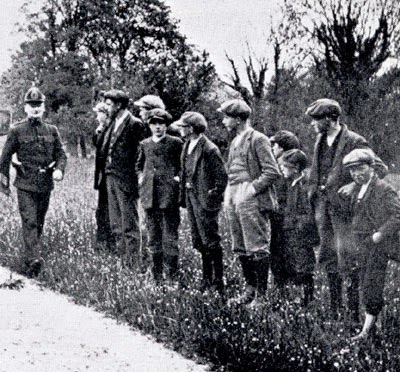 |
| Boys watching an eviction |
A pattern quickly emerges of a privileged class who lived very different lives from those of their tenants. The average life expectancy of a tenant farmer in Ireland was about 40 years. Childhood mortality was high- Richard and Margaret Allen did well to raise ten children to adulthood. One third of the tenant families in Meath in 1851 lived in one room, smoky, windowless mud cabins. [1] With restrictions on schooling, few adults could read or write. Tenants could be evicted from their homes with little or no notice, and any improvements which a tenant family made on their homes or fields became the property of the landlord- which led to a sense of frustration regarding money and effort spent on spent on improving existing conditions. It was an insecure existence, with little hope of a better future.

There had been food shortages in the past, but 1845, 1846, and 1848 brought blight- a horrible disease with no cure- one which blew in on an ill wind and spread from field to field overnight. The potato- which was cheap, nutritious, and easy to grow- had become the main crop for most poor families in Ireland. Now, along with the disease, panic spread- throughout Meath and all over Ireland- as the blight turned previously healthy green potato plants black and rotted the potatoes which had already formed in the ground into inedible stinking slime. Not only was their meagre cash crop gone; worse, so was the main source of food for nearly all tenant families. They watched helplessly as their previously green healthy fields turned into black disease ridden wastelands.

Richard and Margaret Allen had nine children when the blight hit. In 1846, during the height of the "great hunger" years, Mary (age 20) and Franklin (age 17) were surely out of school and may have found outside jobs to help bring in money for the family to live on. John (13,) Hugh (12,) Patrick (11,) Peter (9,) and Richard (7,) may have been lucky enough to stay in school and help out in the fields part time. At home, Margaret still had two very young children- Thomas age 5, and Edward age 2- and she was pregnant with her last child- Catherine- who would be born in May 1847- in the midst of the famine.
The survival of all ten children in the Allen family shows that they were among the more fortunate within the struggling Irish population. Perhaps with a slightly larger farm they had been able to grow a greater variety of crops, with other vegetables that were unaffected by the horrible blight. It would have helped to have enough animals on the farm to feed them and provide for a tiny bit of cash to see them through for a time in the midst of the chaos. But surely it was a time of want and suffering for all families. To make matters worse, the winter of 1846-1847, while Margaret was pregnant with Catherine, was a bitterly cold one, with unusual snows and a harsh blizzard. For families already short on turf for heat, every family would have been miserably cold in their simple cottages.
Perhaps the hardest thing would have been seeing friends and neighbors who had only tiny plots of land and who subsisted largely on their potato crops as they suffered during the hungry years. As starvation set in and bodies weakened, people became ill. Typhus, dysentery, and fevers spread throughout the whole population. Margaret Allen would have been in constant fear for the health of her family. School may have been shut down at times during the worst of the fevers, which spread rapidly through communities. Surely the family traveled wearily to the church in Dangan to stand by gravesides as neighbors buried their loved ones taken by fever or famine.

To make matters worse, in 1849 land values fell sharply and throughout Ireland, landowners began to auction off their estates. New owners tended to be harsher in evicting tenants in an attempt to consolidate the existing tiny plots of farmland into profitable grazing land for cattle. Rents were raised, and mass evictions conducted. Between 1849 and 1850 nearly 50,000 additional families were evicted throughout Ireland.
As evictions increased, whole families roamed the roads on the way to the cities of Trim and Dublin, begging for food. Many died right along the roadside. Some were driven to thievery in their desperate attempts for survival.The penalties for stealing were harsh; in the Trim sessions in 1849 are recorded typical punishments; ten years transportation for stealing bacon, a fortnight in prison for stealing bread, a year in prison for stealing a sheep, eight months in prison for stealing turf to heat their homes. [3]

There was an attempt at construction projects, such as those led by the Allen's landlord, Charles P. Leslie. Over 700,000 people were hired in these projects, but the wages were often so low that they were not enough to keep the workers' families from dying of starvation. Government soup kitchens opened up offering a bowl of porridge and a slice of bread each day. Starvation in Meath was rampant; one visitor in the Trim district found a father dead of starvation on his cottage floor, with his starving children around him, too weak to make the trip to the poorhouse. [4]

The poorhouse, or workhouse, was infamous as "the most feared and hated institution in Ireland." [5] Great Umberstown, where the Allens lived, was in the Trim workhouse union, and their taxes helped to support the workhouse there, which was built in 1841 as a home for paupers. But the workhouse was a last resort for families, who dreaded the possibility of ending up there. Perhaps the worst part of the experience was that families were immediately split up and might only see each other once a week. Men and women were housed in separate areas, and children over the age of 2 were taken from their mothers. Many children were hired out to work-which was thought to increase their chances of survival. In 1850, four thousand young girls, age 14-19, (100 of them from Meath,)[6] were shipped from the workhouses to Australia. Rules in the workhouse were extremely strict- even for Victorian times. Clothing and food was of the poorest level; the philosophy being that the workhouse should not be a place where people would want to go if they could live better outside its walls. The poor conditions normally kept the population of the workhouse low; but by the end of the famine, overcrowding became a problem in many areas. Disease entered with the poor, despite separate fever hospitals, and many died.

Between 1845 and the end of the famine in 1852, it is estimated that a million people died of starvation and disease in Ireland. [7] Another million people were lost to immigration.
1846 famine- Samuel Craig was a probationer to a presbyterian congregation of 20 persons in Summerhill. He became secretary for the famine relief committee and distributed "stirabout" to about a thousand people a day. In 1847 there was a cholera epidemic and he established a fever hospital in the outbuildings of a local nobleman. When the doctor was too weak to care for patients, Craig nursed them and even obtained coffins for the poor.
[1] Navan Historical Society http://www.navanhistory.ie/index.php?page=lost-generations
[2]Researching the Irish Famine http://www.nli.ie/blog/index.php/2012/01/20/researching-the-irish-famine/
[3] http://www.irelandoldnews.com/Cavan/1849/JUL.html
[4] Victorian Childhood; Themes and Variations by Thomas Edward Jordan p 14
[5] Irish Workhouse Centre
http://irishworkhousecentre.ie/the-workhouse-story/#
[6] Navan Historical Society http://www.navanhistory.ie/index.php?page=the-great-hunger-2
[7] http://www.archaeology.co.uk/articles/features/the-kilkenny-workhouse-mass-burials-an-archaeology-of-the-great-irish-famine.htm
8) meathhistoryhub.ie/summerhill-presbyterians