Friday, May 16, 2014

Allen Blog- Hugh's Story- Part 7- The Leslies- Landlords of the Allens


The Leslie Family 1905 [all photographs by Mark Leslie- see citation at end]


It is unlikely that the Allen's ever met their landlord, Charles Powell Leslie. His vast estates throughout Ireland were handled by agents who collected the rents and took care of the details regarding the lands and their tenants. The Leslie family lived on their country estate in County Monaghan in Northern Ireland.  Like most wealthy families of the time, they also likely kept a Dublin residence for the social season there (Christmas to St. Patrick's Day) and then a London residence for the summer ball season- to introduce their daughters to society. When on their Irish country estate, they would have spent leisure time shooting, fox hunting, and entertaining at dinners and balls. Their home was a showcase, filled with symbols of wealth and works of art. [1]


The lives of the Leslies were a world apart from those of their tenants. Children were educated at home by governesses and tutors and then boys were sent on to Eton or Harrow before college. A grand tour in Europe would have been considered a part of their education for most. 


The indoor staff at Castle Leslie 1890


Norman and Shane Leslie with their father 1897


Charles Powell Leslie II (1769-1831) would have spent a great deal of time in Dublin, as his father was a member of Irish Parliament representing their home estate in County Monaghan. He was educated at Oxford and became a colonel for the Monaghan Militia, which succeeded in putting down the 1798 Irish Rebellion. According to Irish Leader Daniel O'Connell, he was "one of the most uncompromising enemies of his Catholic country men." [2]Moving to London to sit in Parliament there, Leslie voted against proposals for Catholic Relief in 1811 and Catholic Emancipation and lost his seat in Parliament on that issue in 1826.

His son, Charles Powell Leslie III (1821-1871) was ten years old at the death of his father. He came of age during the famine years and was much more supportive of his tenants than his father had been. He promoted free education for local farmers to study scientific farming methods. [3] During the famine years, this generation of Leslie's was known to suspend payment of rents for struggling tenants and there is no record of them ever evicting tenants during these hard years while Ireland suffered from widespread mass evictions. Leslie also organized relief work to try and provide income for families during the famine years, and his mother set up soup kitchens to provide for the starving. [4]


Lady Leslie with local school children in Glaslough 1890


His heir, Sir John Leslie, built Castle Leslie in Monaghan in 1870 on a 1000 acre estate. His wife, Lady Leonie Jerome Leslie, was the sister of Jennie Jerome Randolph Churchill, who was the mother of Winston Churchill.


Lady Leonie Leslie (on far right) with her mother and sisters (Jennie Churchill standing with Winston on her left)


The eldest son and heir, Norman Leslie, was tragically killed in WWI. His brother, Shane Leslie, inherited the estate. Interestingly, he converted to Catholicism (and as a result was disbarred; but remained the heir.) He also married an American, Marjorie Ida, a native of Vermont (who was actually raised in American Samoa, where her father was a diplomat!)


Marjorie wife of Shane Leslie at Castle Leslie


Lady Leonie Leslie with Princesses Elizabeth and Margaret


Castle Leslie in County Monaghan is still in the possession of the Leslie family, and is open to paying guests. The chapel there gained notoriety recently when it served as the wedding place of Paul McCartney.[5] An extensive history and virtual tour is available on the Castle Leslie website:


*All photographs on this page were submitted by Mark Leslie to "Edwardian Country House Life" on "Travelers 411."  More of his photo collection on the Leslie's can be seen on that site.

https://www.travelers411.com/forums/album.php?albumid=721


Thursday, May 15, 2014

Allen Blog- Hugh's Story- Part 6- Nearby Towns and Market Days

Market Day [1]


                          Market Day


Market days were held in the nearby town of Summerhill to the southeast and in the historic medieval town of Trim to the north. The pretty village of Summerhill was a little over three miles from Great Umberstown. [2] This would be about an hour’s walk- although if they owned a horse and cart, with any luck the cart was piled high with produce for sale on market day! Although this distance may seem a long way walk for us, the folk of the time routinely walked much farther than we do today, and walking was considered an enjoyable pastime- with a day at the town market a much anticipated outing. This was a chance not just to buy and sell goods, but to visit with other friends and neighbors, catch up on news and gossip, and for young people, a chance to court potential sweethearts. Fairs were held in April, June, September, and November.


[3]


                                       Summerhill


The village of Summerhill had first been known as “Lynches Knock” and the ruins of the original castle, could still be seen there. This was the site of the Battle of Dungan’s Hill in the 1600’s, where the Irish army was defeated in their march toward Dublin. Afterwards, Cromwell gave this land to the Protestant Bishop of Meath, who sold it to Sir Hercules Rowley, Baron Langford, who abandoned the castle to build a new family home in the 1730’s, the Summerhill Demesne, which stood outside the village. In 1837 the village had 331 inhabitants and 49 buildings. In 1901 these included a post office, police barracks, doctor’s office, three groceries, bakery (which delivered bread to villagers by horse and cart,) a sweet shop, two pubs, and a tannery.[4]


                                                                                             [5]
Summerhill Post Office circa 1911- postmistress Phyllis Gogarty of Clondoogan (The Gogarty's were friends of the Allens) [6]


A Fair Day in nearby Navan, Meath [7]

Trim


The historic medieval city of Trim, on the river Boyne was about four and a half miles to the north and could be reached by walking in about an hour and a half. [8] 


Trim, which was once the county seat, had weekly markets. In 1837, there were about 570 houses, and 3,000 people residing in the town. There was a flour mill, a brewery, and a tannery, and outside of town a large mill which produced quantities of flour and oatmeal. There were army barracks in the town with about 80 soldiers stationed there. A new courthouse had been built, as well as a county jail which could hold 140 prisoners.[9] 

Trim Castle was home to Ireland’s largest Norman Castle, build in the 12th century. (This castle was used recently in the filming of "Braveheart.") Trim was also once home to historic Catholic monasteries and abbeys, destroyed during the reformation, but whose ruins still existed about the area. Trim was where the dreaded workhouse which was built to house paupers, and a dismal place of last resort for many who faced hopelessness and starvation during the famine years.

Boyne River and bridge into Trim


 Trim circa 1900


Returning from Market [10]

Resources and information on Summerhill history and Summerhill today:

The report below has many pictures of Summerhill- both today and historical- as well as maps of the area:

http://www.meath.ie/CountyCouncil/Heritage/ArchitecturalHeritage/ArchitecturalConservationAreas/File,40004,en.pdf

Shaw's Pub is the local tavern with food and live music:

http://shawspub.wix.com/summerhill


[1] Illustrated London News 1857
[2] Google Maps- directions-See photo tour google maps link https://mapsengine.google.com/map/edit?mid=z2xplTJpQDmE.k36UII-Kc9ik
[3] “A Topographical Dictionary of Ireland 1837 by Samuel Lewis http://www.libraryireland.com/topog/
[7]http://www.navanhistory.ie/index.php?page=fair-green
[8] Google maps- directions- see photo tour google maps link
[9] “A Topographical Dictionary of Ireland 1837 by Samuel Lewis http://www.libraryireland.com/topog/
[10] Illustrated London News 1857


Wednesday, May 14, 2014

Allen Blog-Hugh's Story- Part 5- The Enchantment of Dangan


Dangan Castle, County Meath by Lord Brougham circa 1880


Running along the western border of the Allen farm lay the enchanting ruins of Dangan Castle. This huge estate encompassed woodlands and fields which in turn embraced a fairyland built by adults for their own entertainment- a circular fort, a grotto, the remains of a vast ornamental lake with several islands, an embankment, ornamental obelisks, canals, ruins of the castle, and the ruins of Dangan House. With eight boys, it would be a near miracle if they avoided this attraction- forbidden or not. By the time that Hugh was growing up, this land was more than likely deserted, other than being an attraction for the occasional tourist passing through.


The History of Dangan Castle


Built by Richard Wesley, the first Baron Mornington, this ruin was a showplace in the time of Hugh's grandparents. In 1732 a visitor described a large hall with an organ and harpsichord so guests could enjoy music and dancing. The Baron had grand stables and extensive gardens with hills and vistas, "follies" of Roman temples, ornamental statues, and tall obelisks. The eccentric Baron went on to create canals and large artificial lakes with islands and forts. [1]Here he placed a 20 ton man of war (which he used in mock battles and for firing salutes on family occasions,) a yacht, and a steam boat. The grounds were once surrounded by woodlands and an avenue of trees led to the Italian style "Dangan House" which was added on to Dangan Castle, which was kept as a "folly."  A visitor in 1752 describes his experience there:


"We soon after came to Dangan, the seat of Lord Mornington, situated on a most beautiful flat with an amphitheater of hills rising round it, one over another, in a most beautiful manner; at the lower end is a very large piece of water, at one corner of which is an island; it is a regular fortification; there is a ship, and sloop, and boats on the water, and a yard for building; the hill beyond it is improved into a beautiful wilderness; on a round hill near the house is a temple, and the hills around are adorned with obelisks, pillars, and some buildings; altogether it is the most beautiful thing I ever saw." [2]


Garret Wesley, the first Earl of Mornington, married Anne Hill-Trevor in 1759 and they had six children: Richard, Viscount Wellesley (1760-1842) William Wellesley (1763-1845) Arthur Wellesley the Duke of Wellington (1769-1852) Henry Wellesley (1773-1847) and Anne Wellesley (1775-1844.) (Queen Elizabeth II of England is a direct descendant of Garret Wesley.)[3]The chief claim to fame of the property, was, in Hugh's time, one of its famous inhabitants. It was here that Arthur Wellesley, the future Duke of Wellington (famous for his defeat of Napoleon at Waterloo) spent much of his early childhood, attending the local Protestant school at Trim. 


Portrait of the Duke of Wellington by Sir Thomas Lawrence 1814


Rev. Jonathan Swift Vicar of Laracor Parish Church [5]


Captain Burrows and an Irish Rascal

The Wellesley's, however ran into financial difficulties over the years. In 1793 the estate was sold to Captain Thomas Burrows, who added two wings to the home, including a chapel and a library. In 1803, Burrows leased the house to Roger O’Conner, an Irish Nationalist who was apparently quite a rascal.  Besides eloping with a married lady, he was accused of a notorious train robbery in 1817. He was acquitted of this, claiming that the purpose of the robbery was merely to help him re-capture some love-letters for a friend. It was said that O’Conner had bought Dangan as a place to entertain Napoleon as a guest (expecting a successful invasion of British Ireland by the French) – quite an irony considering the birth of Napoleon’s nemesis in the same house! Instead, over time, O’Conner emptied the place of all valuables, cut down much of the woods for timber, and, after he took out over 5,000 pounds of insurance, the house “mysteriously” caught fire burned.[6]


In Griffith’s Valuation of 1855, Murphy O’Connell is still shown as renting 679 acres in Dangan (the estate) from Thomas Burrows, and Burrows is listed as the landlord for Dangan tenant farmers, including Peter and James Allen. By the birth of Hugh, this once grand estate was basically an abandoned shell of its former grandeur- the lakes dried up, the house and castle empty ruins- a perfect place for curious boys.


Dangan School 


 Hugh probably never realized that his family's former neighbors at Dangan had helped pave the way for him (and children across Ireland) to attend school. The Duke’s brother, Richard, the Marques Wellesley, had also been raised at the Dangan estate. (Some stories say that young Richard started one of the first damaging fires there while making bullets in the attics as a boy.) Richard went on to study at Harrow, Eton, and Oxford. Later serving in parliament, he was instrumental in the passage of the Romans Catholic Relief Act of 1829. The passage of the Act, championed by Daniel O’Connell, an Irish Catholic lawyer, repealed the remaining Penal Laws throughout Ireland. The Marques brother, the famous Duke of Wellington, was also key in its passage through the House of Lords-threatening to resign as Prime Minister if the King did not approve the bill. Soon after passage of this important act, in 1831, the first Irish National Schools were established, paving the way for free education in Ireland.  [7]           


                                Richard, Marques Wellesley [8]

     
The Duke of Wellington arguing in Parliament [9]

The National School, which was run by the parish, was established at Dangan in 1832,[10] and here Hugh and his brothers, sisters and many of their friends would have walked daily to learn to read and write. The 1911 census shows this building as a two room schoolhouse.  These rural schools generally had an open fireplace for heating, and in winter children were required to bring turf to school every day to help provide heat for the building. Since most homes struggled with having enough turf to provide heat at home, this came at a great cost to many families.  English was the required language of instruction.[11] On Sundays, the Allen family attended the church in Dangan, in the Roman Catholic Parish of Summerhill. It was here that their children were baptized, with family and friends serving as sponsors and witnesses.

Dangan Church and School Grounds


In 1911, Our Lady of Lourdes Church was built in Dangan to replace the old parish church. The new Dangan National School is now located on the road between Dangan and Summerhill.[13] The ruins of Dangan Castle and Dangan House remain a tourist attraction, and the estate is currently for sale. (2014)[14]


Dangan House


[1] “North Leinster: The Counties of Longford, Louth, Meath, and WestMeath “by Christine Casey, Alistair John Rowan
[2] Pocoke’s Tour of Ireland in 1752
[3] Wikipedia; Garret Wesley, 1st Earl of Mornington
[6]http://alison-stewart.blogspot.com/2013_02_01_archive.html
[8]Portrait of Richard Colley Wellesley by Thomas Lawrence http://en.wikipedia.org/wiki/File:Richard_Wellesley.jpeg
[9]Painting by Sir George Hayter of the Duke of Wellington (on the right) debating in the issue in 1833 wikipedia
[11]http://www.askaboutireland.ie/learning-zone/primary-students/5th-+-6th-class/history/my-school-history/national-schools-in-the-1/heating/
[12] Map of Griffith's Valuation 1855 
[14] http://www.daft.ie/commercial/dangan-castle-and-lands-trim-road-summerhill-meath/67273/


Tuesday, May 13, 2014

Allen Blog- Hugh's Story- Part 4- Neighbors and Extended Family


[1]

The Lives of Tenant Farmers

The Allens and their neighbors did not own the houses that they lived in or the land on which they had  toiled for generations. They were tenant farmers. The Penal Laws had taken most rights from Irish Catholics- in early times they could not vote, buy land, hold office, possess weapons, or even, in the earliest days, attend school or legally practice their religion. By 1778 Protestants owned 95% of the land. The Penal laws remained in effect until 1829, with the act of Catholic Emancipation. But the results were already entrenched in a society of wealthy Protestant land owners and poor Catholic tenant farmers. Richard Allen and his neighbors leased their land from a gentleman named Charles P. Leslie. 

Neighbors

Great Umberstown was a small rural district with a dozen or so family farms. In the 1901 census for we see remaining neighbors- the Sweeneys, Dorans, Byrnes, Reillys, Mahons, Murrins and Corcorans. Many of these names appeared as baptismal sponsors for the Allen children in earlier years. 

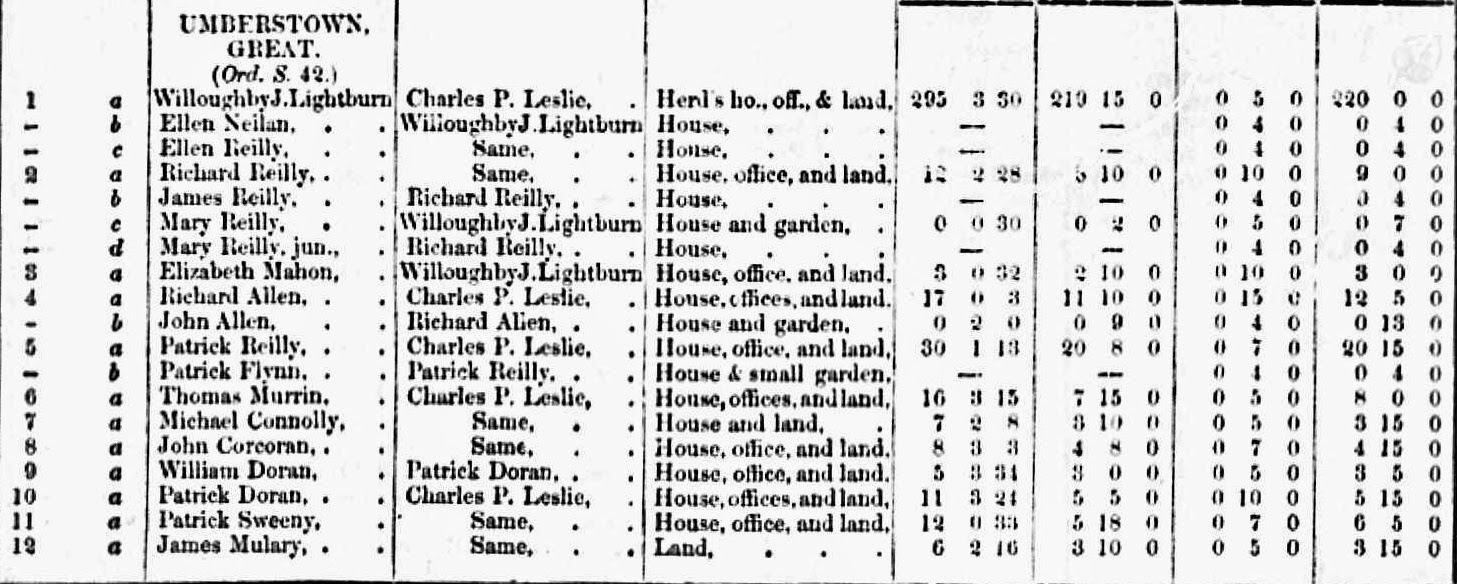
These farms appear in 1855 on Griffith’s Valuation showing their acreage and location (number) on the valuation map. Richard Allen’s home was #4 on the map. Patrick Reilly’s home (#5) was the largest in the area with 30 acres of land. Patrick Sweeney (#11) had 20 acres, Thomas Murrin (#6) 16 acres, William Doran (#9) 11 acres, John Corcoran (#8) 8 acres, Michael Connolly ((#7) 7 acres, and James Mulary (#12) 6 acres. The amount of acreage tells an important story-although the land in Meath was fertile, supporting a large family on less than 10 acres had to be very difficult. 

Also shown in Great Umberstown, next to Richard Allen’s farm, was Willoughby J. Lightburne (#1) with 295 acres. Richard’s neighbor to the west was a Protestant landowner. Lightburne was a lawyer who lived in Trim, his home there being “Harcourt Lodge.”  His father Stafford Lightburne had been a Protestant curate under Rev. Jonathan Swift (author of “Gulliver’s Travels) when he was a minister in the Laracor Church of Ireland.[2] Lightburne would have hired farmers to till his land and care for his grazing animals. This may have been an additional source of income for the Allen family or their neighbors. 

Figure 1- shows the map of Griffiths Valuation of 1855- showing the plots of land of each tenant. Richard Allen was #4- note that the Allen farm borders the Dangan Estate in gray.The other plot numbers match the names of the Great Umberstown neighbors above- Lightburn #1 is to the upper left of the Allen farm.)

 [3]
Figure 2- Griffith's Valuation for Great Umberstown, with map location number, name of tenant, name of landowner, description of property, number of acres, tax value of land, tax value of house, and total taxes due (in pounds and shillings.)


[3]

Nearby family and friends

At this point, we are unsure of who might have been in Hugh’s extended family. But we do know that families of the time were large, and that most people did not move far from their home farms (a fact that was soon to change) so there is a good likelihood that relatives lived nearby. In nearby Dangan, there were 24 residences including James Allen who lived on 5 acres, and Peter Allen lived on 3 acres. Likely friends (names appearing on parish records as baptismal sponsors for the Allen family) were John McCann (19 acres) and Michael Rattigan (4 acres)- all tenants of Thomas Burrows, the owner of the Dangan Estate. 

There were also several Allen (and Sweeney) families in nearby townships- close neighborhoods all within easy walking distance of Great Umberstown. In Ballinrig were 8 residences, including a James Allen with 26 acres and a Rose Allen with 10 acres. Likely friends here were Walter Rattigan, James, Thomas and Peter Byrne, and James Connolly. In Clondoogan were 45 residences, with John Allen (21 acres) Edward Allen (11 acres) and more Byrne, Rattigan, and Reilly families. It is likely that Hugh grew up with numerous aunts, uncles, and cousins.

You can search these records for further clues and see the maps at: 

(County meath, Barony Lower Moyfenragh, Union Trim, Parish Laracor- Great Umberstown is page 7 under Laracor Parish)

[1] London Illustrated Times (google pictures)
[2] Johnathan Swift: A Literary Reference to his Life and Works by Paul J. DeGategno, R. Jay Stubblefield
[3] Griffith's Valuation 1855 chart and map of Great Umberstown 


Monday, May 12, 2014

Allen Blog- Hugh's Story- Part 3 - Hugh's Home and Farm in Ireland


A typical cottage of the time in Meath


A thatched cottage in Meath


Although simple by today’s standards, Hugh grew up in a home that was comfortable compared to the typical Irish farm family. Based on the 1901 and 1911 census of John Allen, his brother, we can get a picture of the home that Hugh likely grew up in. The outside walls of the house were originally made of wood or mud brick, but were later covered with concrete or stone. There were three windows and a door on the front of the house. The roof was thatched - a traditional material in great demand by some homeowners now. Inside, the house had 2-4 rooms for the family of twelve to live in. [1] 

Weather in Ireland could be chilly and wet and the house would have had a central open fireplace to burn the traditional smoky peat turf for heating and cooking. A tea kettle and cooking pot would be hung directly over the fire. Furnishings would have been simple- tables, chairs, and beds or straw stuffed pallets with quilts for the family. 

The Richard Allen family home was taxed at 15 shillings- nearly 3 times the amount of most homes of farmers in the area- which leads us to believe that this was a fairly nice home.  In the valuation, we see that John Allen has a house and garden on Richard's farm. This was taxed for only 4 shillings. At first I thought that this was his son, John, but later came to a different realization- this may well have been his father (or both of his parents.)

John Allen is listed in the 1828 Tithe Applotment Books as living in this area. It would make sense that when he was too old to farm, he (and his wife) would retire to a smaller house with just a garden and leave the main house and farm to his son, Richard. Could John Allen be our ancestor? I think it is highly likely. All eight of Richard's sons would have been home- and unmarried- at the time of the 1854 valuation. It was not the tradition to give land or a home to a son until after they were married and starting their own family...and only one name is listed. John Allen.

Below- Richard Allen’s farm on Griffith’s Valuation of 1854. 

 Richard Allen leases from Charles P. Leslie. The valuation reflects the expected income for the year- thus the Allen farmland would be expected to produce a profit of about 12 pounds 5 shillings each year.[2]  


                                             The Farm


The Allen farm in Great Umberstown consisted of 17 acres of fertile farmland and green pasture. The Knightsbrook River ran through the property, providing abundant water for the family and their animals.[3] Fishing in its waters was likely a favorite pastime of Hugh and his brothers. 

Hugh's mother, Margaret Sweeney Allen, had plenty of room to keep a kitchen garden to provide the family with vegetables and herbs. His father, Richard would have also worked the field crops- which may have included oats, potatoes, and other staples which could be used by the family and for added income.

 Like most small farms of the area, Hugh’s family likely had at least one cow for milk, a flock of chickens for eggs and meat, and a family of pigs for meat and sale for cash at the local markets. With 17 acres, they probably had a donkey to help plow the land and to hitch to a cart to travel back and forth from town and church- but many families of the area walked. 

There would have been a number of outbuildings on the farm; in 1911 we see that there was a stable, cow house, piggery, fowl house, barn, and turf house.[4] (John Allen is #13 on the images below.)

1911 census for John Allen (#13), Great Umberstown, showing barns and outbuildings

1911 Census for John Allen (#13,) Great Umberstown, showing home information


1- 1911 Census for John Allen, Great Umberstown, Meath, House and Buildings
2- Griffiths Valuation 1855, Richard Allen, Great Umberstown, Meath
3- Google Earth 
4- 1911 Census for John Allen, Great Umberstown, Meath,  Out-offices and Farmsteadings


Sunday, May 11, 2014

Allen Blog- Hugh's Story- Part 2- Hugh's Childhood Family


                                              Hugh Allen


                                    Hugh’s Childhood Family

 My mother’s grandfather, Hugh Allen, was born in Ireland on 3 March, 1834.[1]  His parents, Richard Allen and Margaret Sweeney, had been married in Summerhill Parish, County Meath, in 1825. (The Parish registry below shows Rich Allen and Mag Sweeney and their witnesses.)
2


Hugh grew up in a family of ten children. His eldest sister was Mary, born the year after his parents’ marriage, and eight years older than Hugh. There is little doubt that Mary bore many of the household chores and helped with caring for her nine younger siblings- this was a pattern that existed in the family into my mother’s own upbringing- the girls helped with the inside house work and the boys helped with the outside farm work. Hugh had two older brothers- Franklin (also known as “Frank” or “Francis”) who was five years older, and John, who was just a year older than Hugh. Just a year after Hugh’s birth his younger brother Patrick was born, followed by the birth of four more brothers over the next ten years- Peter, Richard, Thomas, and Edward. This household of eight boys was no doubt a crucial help with the daily farm chores but they also probably consumed a good deal of the product- a challenge during the famine years to come. Finally, in 1847 a baby sister was born- Catherine.3 This was the last child to whom Margaret would give birth.

Date of Baptism
 name
Place
Sponsors
1826
28 May
Mary Allen
Summerhill, Meath
John Reely
Mary Murran
1829
3 February
Franklin C “Francis” Allen
Dangan Parish, Summerhill, Meath
Peter Allen
Mary McCann
1833
20 May
John Allen
Summerhill, Meath
Patrick Gugerly
Rose Maran
1834
3 March (birth)
Hugh Allen
Summerhill, Meath

1835
5 June
Patrick Allen
Summerhill, Meath
Jane
1837
28 June
Peter Allen
Summerhill, Meath
Pat Sweeney
Cate McCan
1839
15 Sept
Richard Allen
Summerhill, Meath
Richard Ruley
Honor Corcoran
1841
22 Nov
Thomas Allen
Dangan Parish, Summerhill, Meath
Thomas McCan
Christine Fitzsimons
1844
4 March
Edward Allen
Summerhill, Meath
Patrick Ruley
Catharine Ruley
21 May 1847
Catherine Allen
Summerhill, Meath
Thomas Murns
Ellen Sweeney

Records of baptisms of the children of Richard Allen and Margaret Sweeney- here we see that they were baptized in the church at Dangan, Parish of Summerhill.

Francis 1829


Thomas 1841


(Similar parish records were available for the other children of Richard Allen and Margaret Sweeney- all but Hugh!)


1- Family History Notebooks

2- Ireland, Selections of Catholic Parish Marriages and Banns 1742-1884 (Ancestry.com)

3- Ireland, Select Catholic Birth and Baptism Registers, 1763-1912