Saturday, April 18, 2015

Allen Blog- Hugh's Story- Part 11- The Road West


What brought Hugh and his siblings from N.Y. and New Jersey to Jersey County, Illinois? 

It was a distance of over 900 miles. In 1850 St. Louis was booming, and it was the gateway to the west. Steamboat travel took the traveler to its doorstep; St. Louis was a major inland port. Irish and German immigrants soon flocked to the city. St. Louis was the end of the stage coach line from the east, and soon became the starting point for trails to the west- a growing interest after the discovery of gold in 1849.  Railroads also spread in this direction- although in 1850 there was no bridge to cross the Mississippi. Passengers and freight were hauled across the river by ferries. By 1860 the city had a population of over 160,000 people. (1)


The western lands beckoned to immigrants, and promoters published guidelines to encourage them to settle in the west. Below is an extract from Mr. Peck's "Emigrant's Guide" reproduced in "Illinois in 1837, published by S. Augustus Mitchell.

                                                        "Suggestions to Emigrants"
Canal, Steam boat and Stage Routes- Other Modes of Travel- Expenses- Roads, Distances, etc.

“…Having decided to what state, and part of the state, an emigrant will remove, let him then conclude to take as little furniture and other luggage as he can do with, especially if he comes to public conveyances. Those who reside within convenient distance of a sea port, would find it both safe and economical to ship by New Orleans, in boxes, such articles as are not wanted for the road, especially if they steer for the navigable waters of the Mississippi. Bed and other clothing, books, &c. packed in boxes, like merchants' goods, will go much safer and cheaper by New Orleans, than by any of the inland routes….”


The most expeditious, pleasant, and direct route for travelers to the southern parts of Ohio and Indiana; to the Illinois river, as far north as Peoria; to the Upper Mississippi as far as Quincy, Rock Island, Galena and Prairie du Chien; to Missouri, and to Kentucky, Tennessee, Arkansas, Natchez and New Orleans, is one of the southern routes. These are, 1. From Philadelphia to Pittsburgh, by railroads and the Pennsylvania canal; 2. By the Baltimore and Ohio railroad and stages to Wheeling…”

Portion of map entitled
"Principal Routes of Trade and Migration 1840-1850" 
Canals solid red, rivers dotted red, railroads green (a)

 From Philadelphia to Pittsburgh, by railroad and canal was 394 miles. The “Pioneer Line”, for passengers only, advertised a four day journey for $10. The “Western Transportation Line” which took both passengers and freight, advertised a five day journey for $7, or six and a half days for steerage passengers, 8 days for freight. Emigrants were advised not to carry more than a small trunk or two on these packet lines. Meals were provided for 37.5 cents.

Erie Canal- If Hugh took this route he would have seen many cities along the way- Albany, Syracuse, Rochester, and Buffalo (c)


                (d)

At Pittsburgh, one could board a steam boat. From Pittsburg to Cincinnati was $10, from Cincinnati to Louisville, $4, from Louisville to St. Louis, $12. Meals were included on the steam boats. This however, was rather a luxurious travel style, unaffordable for most emigrants. Deck passage was also available, however, Pittsburg to Cincinnati $3, Cincinnati to Louisville $1, Louisville to St. Louis $4.


“The deck for such passengers is usually in the mid-ship, forward of the engine, and is protected from the weather. Passengers furnish their own provisions and bedding. They often take their meals at the cabin-table, with the boat hands, and pay twenty-five cents a meal. Thousands pass up and down the rivers as deck passengers, especially emigrating families, who have their bedding, provisions, and cooking utensils, on board.”
  
“The whole expense of a single person from New York to St. Louis, by the way of Philadelphia and Pittsburgh, with cabin passage on the river, will range between $40 and $45; - time, from twelve to fifteen days. Taking the transportation lines on the Pennsylvania canal, and a deck passage in the steamboat, and the expenses will range between $20 and $25, supposing the person buys his meals at twenty-five cents, and eats twice a day. If he carry his own provisions, he passage, &c. will be from $15 to $18.”

The brochure goes on to suggest:


“Farmers who remove to the west from the northern and middle states, will find it advantageous, in many instances, to remove with their own teams and wagons. These they will need upon their arrival. Autumn, or from September till November, is the favorable season for this mode of emigration. The roads are then in good order, the weather usually favorable, and feed plenty. People of all classes, from the states south of the Ohio river, remove with large wagons, carry and cook their own provisions, purchase their feed by the bushel, and invariably encamp out at night.”


“Individuals who wish to travel through the interior of Michigan, Indiana, Illinois, Missouri, &c., will find that the most convenient, sure economical, and independent mode, is on horseback. Their expenses will be from seventy - five cents to one dollar fifty cents per day, and the can always consult their own convenience and pleasure, as to time and place.” (2)


The National Road to St. Louis (b) The Stagecoach ran along this road, or travelers could take their own mode of transportion.

Did Hugh travel by horseback, wagon, stagecoach, or a combination of steamboat, canal packet boat, rail and stagecoach? We can guess that he came by the most affordable method of travel at the time. In any case, it was his chance to see America along the way- surely an adventure for any young man.

 An early emigrant who came from New York to Jersey County, Illinois stated “Almost constant traveling, and trying to travel had brought me to the land of promise. We got onto the rise of land about four miles south of Jerseyville, where we could see the little town. It was not much to look at four miles off, but the fine prairie, so rich, so beautiful, grand and enchanting. I broke out with feelings of great emotion and gratitude to God for what my eyes beheld, for I had never looked upon so grand a sight before. There was considerable farming done near the town, and still great, beautiful prairies lay out with hundreds of cattle feeding them, and they were worth about five to ten dollars per acre, and no sale, no money, no confidence. The prices of produce were as you might have a chance to trade something for something else.
      I bought what I considered as good a team of horses as there was in the country for one hundred and ten dollars, and four yoke of oxen, with yoke and chain, at $25 per yoke. Times were hard then, but we could live, and the prospect was so good it gave courage, and we have more than realized all that we anticipated. I can, with joy and satisfaction, say I am glad I live in Illinois.” (3)


Sources of Information:
1- https://www.stlouis-mo.gov/archive/history-physical-growth-stlouis/

Sources of illustrations: 

a- Dixon Ryan Fox, Harper's Atlas of American History (New York, NY: Harper & Brothers Publishers , 1920) 47 Map Credit: Courtesy the private collection of Roy Winkelman  http://etc.usf.edu/maps

b-Transportation between the east and west during the Canal Era (1825—1850). Source: S.E. Forman, Advanced American History (New York, NY: The Century Company, 1919) 327 Map Credit: Courtesy the private collection of Roy Winkelman; link http://etc.usf.edu/maps

c-"Map showing Present and Proposed Canal System" -- from: Annual report of the State Engineer and Surveyor of the State of New York, for the fiscal year ending September 30, 1903. (Albany : Oliver A. Quayle, 1904) -- facing p. 60.  http://www.eriecanal.org/maps.html
  
d-Illustration by William Roberts in Jacob Abbott's Marco Paul's Voyages and Travels, Erie Canal.  New York: Harper & Brothers, 1852 edition, p 44.


Monday, May 19, 2014

Allen Blog-Hugh's Story- Part 10- Hope for new world- Immigration to America

                     Immigration


The DeWitt Clinton, built 1848, wrecked off the coast of New Jersey in 1860. A Patrick Allen, age 21, is on the May 1856 sailing of this ship.
The Allen children were young during the height of the famine, but as the famine eased, they reached their maturity. The Allen offspring, like many of their neighbors, delayed marriage and starting a family in those tough times. The eldest, Mary, was 25 when she married Patrick Byrne in 1851 in Summerhill.


Mary and Patrick may well have been the first members of the family to immigrate to America. The records of immigration are confusing at best, but it does appear that Mary's first child, Anna Burns, was born in New Jersey in 1856. (The 1900 census shows them immigrating in 1860, but also being married in 1860....which is not correct according to the information in the Dangan church register above.) The 1870 census of Jersey County, Illinois shows Anna, age 15 (born abt. 1855) and Patson, age 13 (born abt. 1857) both born in New Jersey. The first child born in Illinois was Franklin, age 11 (born 1859.) The spelling of "Byrne" has been changed to "Burn" by the time of this census.  Mary also appears to be the only Allen who was married in Ireland before immigrating to America.


Our family history tells us that Hugh Allen arrived in America at Castle Garden, New York, and lived and worked in New York for a few years before moving to Illinois. We know that he was in Illinois before 1863, when he registered for the civil war draft. We know that his brother, Franklin, was in Jersey County Illinois by 1861, when his daughter Delia was born there. The 1930 census claims that brother Thomas came to the U.S. in 1861.

Register of the Joseph Gilchirst from November 1857, showing a Hugh Allen, age 26, sailing from Liverpool to New York


Immigration records have been hard to trace- many burned in a fire on Ellis Island. But some ship registers remain. There is a Patrick Allen, age 21, who arrived onboard the DeWitt Clinton at Castle Garden in June 1856. There is a Hugh Allen, age 26,  who arrived onboard the Joseph Gilchrist in November 1857.  In any case, it is unclear whether the Allen brothers traveled to America together, or individually, as money was saved to get them passage. What we can guess at, however, is that they had similar experiences along the way.

Leaving Summerhill

When Hugh left home, whether alone or with one or even two brothers, it must have been with a many mixed emotions- a heart heavy with grief at leaving his parents (whom he would never see again) and full of the excitement of a young man starting out on his own on his way to a new land full of hope and opportunity. He would have been in his mid-twenties, and already an experienced farmer who was not a stranger to hard work and tough times.

Did the family travel with him to nearby Dublin to wave goodbye to him as he caught the boat across the Irish Sea to Liverpool, or did they say goodbye at home, or in the village? Either way, it was surely a heartbreaking farewell.


Embarkation at Waterloo Docks- Liverpool


The steamer from Dublin took less than three hours to reach Liverpool. Once in the port of Liverpool, Hugh would have had at least a one night stay, probably in less than desirable lodgings near the docks, while he arranged for his passage. In Liverpool, passage brokers arranged for fares, which averaged about 5 pounds for steerage passage. 

A passage advertisement to New York via steamer


Hugh would have signed a passage contract, and been given his ticket.


Hugh and his fellow passengers had to go through a medical examination before they were allowed to board the ship. This was an effort to keep the ships free from the dreaded fever. Those who passed had their tickets stamped and were allowed to board the ship 24 hours before sailing. Hugh would have carried his few possessions on board, jostling with about 400 other passengers to find a spot between decks for the voyage, which would last 3-4 weeks.


Ships were towed ten miles down the Mersey River while the crew onboard conducted a search for stowaways- a common practice among those who could not afford the fare. Those caught in time were put ashore- others were used as laborers during the voyage. All the ticketed passengers assembled on the quarter deck, where the ship's officers conducted a roll-call comparing tickets and the passenger list. This often took 2-4 hours.(First class passengers in cabins were exempt.) After the roll-call was completed, the steerage passengers were allowed to go back to their berths between decks.


The beginning of the voyage was often a time of great celebration among the passengers,  with new friendships made and great hope for better times to come. Many passengers were young adults, and there was time for country music with fiddle and flute and dancing with new acquaintances.

The accommodations themselves were simple. Passengers were given an allotment of food, which could be cooked on deck in good weather, or below deck in foul weather. Some ships provided a cook. The food was simple; bread, flour, oatmeal, rice or potatoes, and tea. Passengers were expected to supplement this with  their own supplies.

If seas were calm, steerage passengers were allowed time on deck, but in foul weather, they were crowded into their space between decks.


Once arriving in New York, ships were again checked for fever. Those with fever aboard were  quarantined for 30 days on Staten Island. Those with healthy passengers were allowed to disembark at Castle Garden, on the lower tip of Manhattan. New York received over 650,000 Irish immigrants during the famine years- giving the city a larger population of Irish born citizens than Dublin.


Once in Castle Garden, Hugh would have had to find his way in the city. Many Irish countrymen were set up on the docks trying to make a penny out of steering the new immigrants along- to their friends boarding houses, etc. The ghettos of New York were full of poor Irish immigrants trying to find jobs and begin making their way in this new country. If Mary and her husband were already in New Jersey, Hugh was lucky indeed to have someone to help him get adjusted and find employment. According to the "History of Jersey County" he continued working for a time in New York state before heading west.


Sunday, May 18, 2014

Allen Blog-Hugh's Story-Part 9- The Famine

The Famine


Eviction

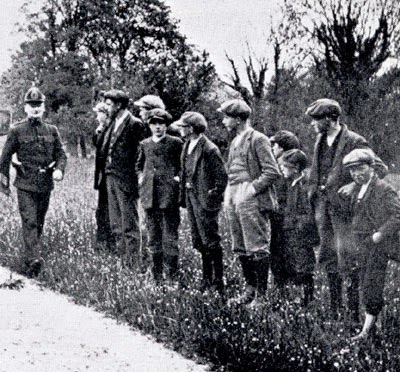
Boys watching an eviction

A pattern quickly emerges of a privileged class who lived very different lives from those of their tenants. The average life expectancy of a tenant farmer in Ireland was about 40 years. Childhood mortality was high- Richard and Margaret Allen did well to raise ten children to adulthood. One third of the tenant families in Meath in 1851 lived in one room, smoky, windowless mud cabins. [1] With restrictions on schooling, few adults could read or write. Tenants could be evicted from their homes with little or no notice, and any improvements which a tenant family made on their homes or fields became the property of the landlord- which led to a sense of frustration regarding money and effort spent on spent on improving existing conditions. It was an insecure existence, with little hope of a better future.


There had been food shortages in the past, but 1845, 1846, and 1848 brought blight- a horrible disease with no cure- one which blew in on an ill wind and spread from field to field overnight. The potato- which was cheap, nutritious, and easy to grow- had become the main crop for most poor families in Ireland. Now, along with the disease, panic spread- throughout Meath and all over Ireland- as the blight turned previously healthy green potato plants black and rotted the potatoes which had already formed in the ground into inedible stinking slime. Not only was their meagre cash crop gone; worse, so was the main source of food for nearly all tenant families. They watched helplessly as their previously green healthy fields turned into black disease ridden wastelands.


Richard and Margaret Allen had nine children when the blight hit. In 1846, during the height of the "great hunger" years, Mary (age 20) and Franklin (age 17) were surely out of school and may have found outside jobs to help bring in money for the family to live on. John (13,) Hugh (12,) Patrick (11,) Peter (9,) and Richard (7,) may have been lucky enough to stay in school and help out in the fields part time. At home, Margaret still had two very young children- Thomas age 5, and Edward age 2- and she was pregnant with her last child- Catherine- who would be born in May 1847- in the midst of the famine.


The survival of all ten children in the Allen family shows that they were among the more fortunate within the struggling Irish population. Perhaps with a slightly larger farm they had been able to grow a greater variety of crops, with other vegetables that were unaffected by the horrible blight. It would have helped to have enough animals on the farm to feed them and provide for a tiny bit of cash to see them through for a time in the midst of the chaos. But surely it was a time of want and suffering for all families. To make matters worse, the winter of 1846-1847, while Margaret was pregnant with Catherine, was a bitterly cold one, with unusual snows and a harsh blizzard. For families already short on turf for heat, every family would have been miserably cold in their simple cottages.


Perhaps the hardest thing would have been seeing friends and neighbors who had only tiny plots of land and who subsisted largely on their potato crops as they suffered during the hungry years. As starvation set in and bodies weakened, people became ill. Typhus, dysentery, and fevers spread throughout the whole population. Margaret Allen would have been in constant fear for the health of her family. School may have been shut down at times during the worst of the fevers, which spread rapidly through communities. Surely the family traveled wearily to the church in Dangan to stand by gravesides as neighbors buried their loved ones taken by fever or famine.


To make matters worse, in 1849 land values fell sharply and throughout Ireland, landowners began to auction off their estates. New owners tended to be harsher in evicting tenants in an attempt to consolidate the existing tiny plots of farmland into profitable grazing land for cattle. Rents were raised, and mass evictions conducted. Between 1849 and 1850 nearly 50,000 additional families were evicted throughout Ireland.


As evictions increased, whole families roamed the roads on the way to the cities of Trim and Dublin, begging for food. Many died right along the roadside. Some were driven to thievery in their desperate attempts for survival.The penalties for stealing were harsh; in the Trim sessions in 1849 are recorded typical punishments; ten years transportation for stealing bacon, a fortnight in prison for stealing bread, a year in prison for stealing a sheep, eight months in prison for stealing turf to heat their homes. [3]


There was an attempt at construction projects, such as those led by the Allen's landlord, Charles P. Leslie. Over 700,000 people were hired in these projects, but the wages were often so low that they were not enough to keep the workers' families from dying of starvation. Government soup kitchens opened up offering a bowl of porridge and a slice of bread each day. Starvation in Meath was rampant; one visitor in the Trim district found a father dead of starvation on his cottage floor, with his starving children around him, too weak to make the trip to the poorhouse. [4]


The poorhouse, or workhouse, was infamous as "the most feared and hated institution in Ireland." [5] Great Umberstown, where the Allens lived, was in the Trim workhouse union, and their taxes helped to support the workhouse there, which was built in 1841 as a home for paupers. But the workhouse was a last resort for families, who dreaded the possibility of ending up there. Perhaps the worst part of the experience was that families were immediately split up and might only see each other once a week. Men and women were housed in separate areas, and children over the age of 2 were taken from their mothers. Many children were hired out to work-which was thought to increase their chances of survival. In 1850, four thousand young girls, age 14-19, (100 of them from Meath,)[6] were shipped from the workhouses to Australia. Rules in the workhouse were extremely strict- even for Victorian times. Clothing and food was of the poorest level; the philosophy being that the workhouse should not be a place where people would want to go if they could live better outside its walls. The poor conditions normally kept the population of the workhouse low; but by the end of the famine, overcrowding became a problem in many areas. Disease entered with the poor, despite separate fever hospitals, and many died. 


Between 1845 and the end of the famine in 1852, it is estimated that a million people died of starvation and disease in Ireland. [7] Another million people were lost to immigration.

1846 famine- Samuel Craig was a probationer to a presbyterian congregation of  20 persons in Summerhill. He became secretary for the famine relief committee and distributed "stirabout" to about a thousand people a day. In 1847 there was a cholera epidemic and he established a fever hospital in the outbuildings of a local nobleman. When the doctor was too weak to care for patients, Craig nursed them and even obtained coffins for the poor.


[1] Navan Historical Society http://www.navanhistory.ie/index.php?page=lost-generations
[2]Researching the Irish Famine http://www.nli.ie/blog/index.php/2012/01/20/researching-the-irish-famine/
[3] http://www.irelandoldnews.com/Cavan/1849/JUL.html
[4] Victorian Childhood; Themes and Variations by Thomas Edward Jordan p 14
[5] Irish Workhouse Centre
 http://irishworkhousecentre.ie/the-workhouse-story/#
[6] Navan Historical Society http://www.navanhistory.ie/index.php?page=the-great-hunger-2
[7] http://www.archaeology.co.uk/articles/features/the-kilkenny-workhouse-mass-burials-an-archaeology-of-the-great-irish-famine.htm
8) meathhistoryhub.ie/summerhill-presbyterians